Latest Posts

Going for the Happiness Advantage (Taking My Kids Too)

happiness ball
New year. Happiness Advantage. High quality stuff for 2013.

2-5 minutes a day, 21 days. Founded in science. Grab on yourself, and bring along your kids.

Let’s look at the science, then we’ll dive into the good stuff. First, let me credit Shawn Anchor, distinguished Harvard professor, for this. Through research, he has summed up that:

Only 10% of long-term happiness comes from one’s external world . . .

While 90% of long-term happiness comes from how one’s brain processes the world.

As you raise your brain’s level of positivity in the present, your brain will experience the Happiness Advantage. In this state, a number of remarkable things happen.

Dopamine releases throughout your system. This makes you happier . . . and it turns on all your learning centers.
Your intelligence increases. Your creativity increases. Your energy levels rise.
And, your brain is 31% more productive.
That’s cool. That’s cool for us. And for our kids.

Shawn Anchor has found (in research) that we can train our brains to reach the Happiness Advantage – and thus long-term happiness – 2-5 minutes a day, in 21 days.

Let’s take this one step at a time – by ourselves – and let’s lead our kids.

Step #1
For the next two days, write down 3 NEW things for which you are grateful, each day. Have your kids do it too. That’s it. Today – 3 new grateful things. Tomorrow – 3 new grateful things.

Stay tuned for Step #2. I’ll see you then.

An ExtraOrdinary New Year

polar bear happy new yearA new year is here. We all approach it a bit differently. Are you jumping in to make the resolution list? Or taking it all in and waiting to see where 2013 might take you? Whether you’re immediately seizing the New Year or letting it more calmly embrace you, here is a neat concept (given to me yesterday by our local pastor).

She said: Be extraordinary in an ordinary world. Find the kindness, the generosity, the love in your heart . . . and spread it. Do the extraordinary things that just might not seem ordinary in our world.

Being extraordinary can mean big things, of course; or it can mean those little things in our “ordinary” daily world – like letting the person go ahead of you. Holding the door. Opening the door. Looking for ways — big and small — to help someone out.

That’s where I’ll start this year (with just a few more on the list). At least one extraordinary thing each day — big or small. Maybe it will be like paying it forward.

I’m going to pass along the extraordinary proposition to my kids, too. Wish me luck . . . and have an extraordinary day.
p.s. Stay tuned for the “Happiness Advantage” for 2013. We’re just getting warmed up.

Happiness: Inside Out

happiness photo

The new year is approaching. The “Happiness Advantage” has captured my attention.

Alex Hetland gives us a formula to increase our “happy” state and make our brains 30% more efficient — in 2-5 minutes a day. That’s cool. It’s cool for us parents; and it’s cool for our kids, especially our adolescents.

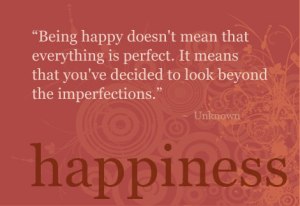
Consider for a moment that only 10% of happiness comes from one’s external world . . . while 90% of one’s happiness is a result of one’s internal world.

This is supported in science.

Having recently discovered the concept of the “Happiness Advantage,” conveyed by Alex Hetland, I have enjoyed a renewed perspective on happiness, and all which that entails.

Within the “Happiness Advantage,” there is scientific proof that a “happy” state increases dopamine in the brain, which in turn makes the brain 30% more efficient (Lyubomirsky, 2005, in Hetland blog of March 2012).

So, Hetland says, the “Advantage” comes from grasping the 90% happiness factor in our internal world — and maximizing it. He even tells us how to do so. With life-lasting effects, 2-5 minutes a day, in just 21 days.

Stay tuned. This is high-quality stuff for 2013.

See you then.

Bah-Hum–Moan? Holiday Spirit and (Pre)Teens

hAs we move through the events of the weekend, and approach Christmas, the concept of “holiday spirit” is occupying my mind. It sure has been hard to keep it alive in the events of last Friday. Yet, here we are, approaching that special day of the year. And here I am, with a nine year old effervescing with holiday spirit, while her almost thirteen year old brother appears to approach this season much more differently than . . . just a year ago? Preferring every-day, regular music over holiday music? What do you mean you don’t want to watch Rudolph this year? (I mean, I get it, I really do get it, but . . . ) . . .

It’s a stage, I know, just like all the others. When they’re little, it’s AMAZING to sit on Santa’s lap, belt out Christmas songs, watch the holiday shows. Not so much in middle school. Yet, there again, in high school, the cool factor of Santa’s lap and Christmas carols often comes around again. I get it (really I do). I can (almost) even accept it (really I can). It’s just that I want to throw a little holiday spirit his way. And I want it to stick. So, this weekend, I pondered. What to do on Saturday night — you know, to “get into the holiday spirit”? Do we go to that notable little street in Baltimore that is famous for its decked-out lights and holiday cheer? Go to a show? Rent a Christmas movie?

We went to Walmart.

We piled in the family van and went to Walmart, together, as a family, to shop for our adopt-a-family. Now, it’s not uncommon for us to give gifts to an unknown family, “adopted” through church, school, and other organizations. And when the kids were little (and the daily moments were much more hectic), I would shop for our adopt-a-families with my son this day, my daughter that other day. They were a part of it. But this year, it was different. We all did it together as a family (for a Saturday night “Christmas” activity). We checked the list, and checked it twice. We talked about their interests, their needs, and their wishes. Then we browsed, we shopped, and we ultimately chose specific and unique things according to each member of our adopt-a-family’s individual wishes.

We all went as a family. Together.

We talked about how our adopt-a-family lived in a homeless shelter, and how different their Christmas would be from ours. We talked about how maybe, just maybe, we would make their Christmas a little better, a little brighter, a little more joyous this year . . . because of our giving.

We “got the holiday spirit” that night. Even the thirteen year old.

Many wishes for you that the holiday spirit makes its way to you, your home, and family, even your (_ _)teen year olds. And, if you want some other ideas about inspiring the holiday spirit in your (pre)teens, let me quote from a recent kidshealth.org/teen article (which includes some other suggested activities): “Happiness is contagious and it multiplies. When one person is happy, it can lift the spirits of others. The more joy you give to others, the more joy you feel.” http://bit.ly/RBLFZN


Coping With The Tragedy

Boy holding onto his mother
In light of the tragic shooting events in Connecticut, how can we cope?

Remember – and remind your children – that there are lots of people helping the children, teachers, and families affected by the tragedy. Although saddened, horrified, angered, and troubled, (with incredible sympathy), for all those involved, try not to let your natural anxiety overshadow your day.

Answer their questions. Remember that children take in everything they see and hear. Kids (even teens) are good observers, but are still learning to interpret and communicate their own feelings. Give children honest answers and information. Provide them with enough information to answer their questions, but be mindful that there is no need to fully describe the details of the event. As with any situation, it is okay not to have all the answers, and it is important to say so.

Keep in mind your own behavior. Children learn from watching us. They watch how we respond to events. They also learn from our conversations with others. Although you are incredibly sad and unsettled, help your children (and yourself) by maintaining a positive outlook. Try not to succumb to the over-riding sadness that can easily take over. Put in place positive thinking and relaxation techniques, and model and share these with your children. Maintaining your own, as well as your child’s regular bedtime, will enable your physical body to better cope with the natural anxiety.

Be available, and maintain a flexible and patient demeanor. Be flexible and allow time for additional questions and concerns to arise. Children may have fearful thoughts and feelings. Be there to comfort with closeness and affection as well as additional time to talk. Keep in mind that some children may worry about their own safety or that of friends and relatives who are away (especially at college). Asking the same questions over and over may be a way for a child to gain reassurance.

Keep news-watching to a minimum.
Ongoing viewing of the same horrific events and related commentary can increase anxiety, fear and stress in both children and adults. If you feel the need to be connected, keep up via the newspaper. It will keep you informed, while lessening the stressful impact of the anxiety and fear on you and your children.

Move your orientation outward. As you are sympathizing with the affected individuals, continue to maintain your outward focus, rather than continuing to focus on your internal feelings and thoughts of sadness and anxiety. Remember that many are helping those affected. Pray for them. Meditate. Help someone else in need in their honor. This holiday season provides us with many opportunities to help those in need. Carry on, reach out, and serve. Involve the family. When we work to help others, where we can, our worries can diminish and we serve for the greater good.

Information compiled from “Talking to Children about Community Violence,” American Academy of Child & Adolescent Psychiatry and “Helping Your Family Cope with Anxiety and Stress,” Parent Education Program (PEP).