Latest Posts

When Your Kid Is Benched

On The Bench

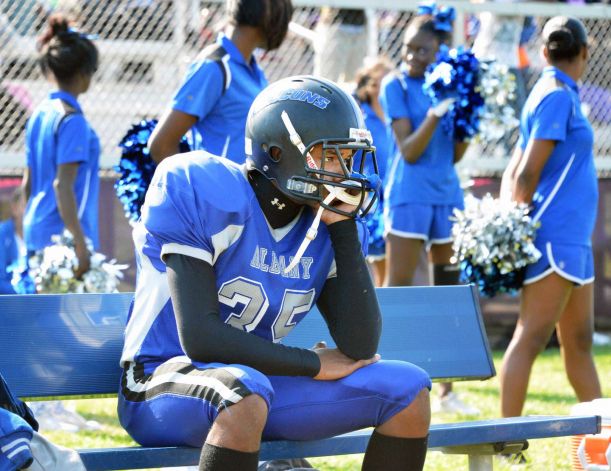
My son was on the bench.  For four weeks.  Injured from his favorite sport.  Or shall I say his passion ?  It was rough, for all of us.  It was physically painful for him, not to mention emotionally painful — for him — and for all of us.  Some kids find themselves on the bench…following an injury…awaiting their call to the line-up…as a result of committing a penalty…or being “put there” by a coach to carry forth a lesson.

What can our kids learn from The Bench?

They learn how to view life, sports, and “the team” from a different perspective —  to see things outside of the box.  A great deal of sports strategies and tactical plays arise from watching from the sidelines.  Some kids on the bench can find themselves in the perfect position to learn not only what to do . . . but what NOT to do.  Sometimes watching from the sidelines can be its own premier training, especially for those visual learners.  It can be prime time viewing of “where I or the team needs to go from here.”   When my son was injured, I encouraged him to take on a consultative role from the bench.  “Become the expert,” I said, “Identify what the team is doing well and what it needs to work on.  Maybe even offer your observations to the coach.”

Kids on the bench can learn how to improve . . . everything from skills and techniques . . . to sportsmanship — or lack thereof.

They learn humility, character, as well as the need for tenacity, patience, and determination from The Bench.  Whether benched because of an injury, a penalty, or developing skills, “that which doesn’t kill you only makes you stronger.”

From the bench, kids can adopt empathy, putting themselves in other (active) players’ shoes.  Seeing how their team members are treated on the field can give them a taste of how they want to be treated — and how to treat others —  both on and off the field.

There are lessons to be had from The Bench.  Embrace them.  Share them with your kid.  It’s a lifelong journey of learning, on — or off — The Bench.

(And, if you’re encountering other . . . learning opportunities . . . with your pre-teen, check out my book:  Bork Reveals the Real Deal about the Facts of Life, perfect for the 9-13 year old boy.)

Family Dinner: Leave it To Beaver . . . or Grab ‘N Go?

 Leave it to BeaverCooking Show

Family dinner:  Is it more like Leave It To Beaver or Grab ‘N Go?  Or something in between?

Me & my house?  We go through phases.

One night . . . the kids will set the table.  And I’ll prepare the meal.  We’ll gather ‘round and talk.  Even have dessert.  Just like Beaver and the Cleavers (well, not exactly.)  Sometimes, two — three — nights in a row.  All of us.  As a family.  Dinner.  Sitting down.  Round the table.  That feels good.

Not only does it bring back visions of Leave It To Beaver, but studies show all kinds of benefits to family dinners:

  • kids who eat most often with their parents are 40% more likely to get mainly A’s and B’s in school than kids who have two or fewer family dinners a week  (National Center on addiction and Substance Abuse at Columbia University via sixsistersstuff.com);
  • adolescent girls who have frequent family meals, and a positive atmosphere during those meals, are less likely to have eating disorders (University of Minnesota, 2004, via zenfamilyhabits.net);
  • when families eat together frequently, children have better language skills compared to kids from families who don’t have family mealtimes often (Harvard University via zenfamilyhabits.net).

Family dinner.  It sounds good.  It looks good.  Especially several nights in a row.  Then, before I know it, I’ll flip the calendar and we grab ‘n go – to our various committed destinations . . . soccer, dance, PTA . . . for another two nights in a row . . . as I’ve thrown the food on the table and we’ve all eaten in shifts.

Like anything else, it takes a balance, doesn’t it, in this busy and demanding world of ours?  How do you manage . . . structure . . . hope for . . . fulfill . . . prepare for . . . your family dinners?  Does it come easy in your household or is it a constant struggle?

If you desire more consistent family meals together . . .

Consider making it a goal (a small, achieveable goal).  What is realistic?  Once a week?  Twice a month?  Monthly?  Or more?  Commit to it.  Even put it on the calendar.  Family meal.  Put it in pen.  Communicate it to the rest of the family, if necessary, to hold the date and priority.

Keep it simple.  Don’t drive yourself crazy thinking you always have to make a fabulous meal.  Keep it simple.  Try sandwiches – something easy & quick .  It’s being together around the table that matters.

Give yourself a break.  Too busy to cook?  Don’t underestimate the value of being together, whether it’s in our homes or out together at a restaurant.  It’s the eating together that counts.

Allow yourself to linger.  Leave the dishes for later.  Don’t feel rushed to leave the table to clean up. Share some dessert and enjoy the time around the table together.  Even if it’s Oreos from the box or fruit from the bowl.  The time spent savoring and sharing dessert is worth it.

Have fun with some conversation startersKeep some of these handy and share some laughs and inner thoughts.

And, lastly, savor the time.  For it goes oh . . . so . . . fast.

When in Rome . . . And Other Life Lessons for Kids

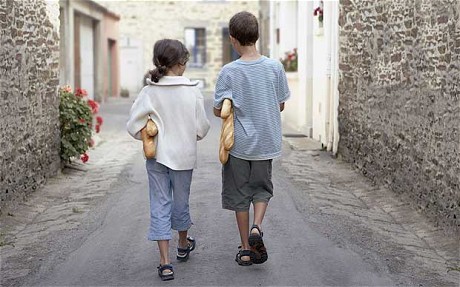
french-kids_2117623c

I want to take my kids to Europe.

See the sights.  Experience the art.  Take in the food . . . the history . . . the culture.

I’ve realized that when I take my kids to Europe it will be more than exposing them to the beauty, the allure, the attraction of Europe – and beyond.

They will also learn . . .

to suck it up  .  .  .  “tiens le coup,” as they say in France.  In English terms, it means:  to withstand the weather; to endure; to tough it out, and to stick it out.

I’m not talking about the “sucking it up” that they learn on a mission trip or otherwise.  That’s another story.  For another time (but certainly on the radar screen).

Taking kids to another country requires them to learn tolerance and the appreciation of differences, while learning to relinquish their advantaged American conveniences.  When in Rome, they learn to do as the Romans do, and so on with the French in France, the Swiss in Switzerland, and the Germans in Allemagne.  There are life lessons to be had among it all – and hopefully life-lasting ones at that.

Pondering this reminds me of the Dutch soccer coach we hosted for a week this summer.  I marveled at his tolerance and acceptance of anything (and everything) American, even though it was clearly a bit foreign and not exactly adherent to his accustomed daily tastes.  Yet he accepted everything with a gracious and pleasant smile; although deep down I knew, at times, he was simply sucking it up – with a grand “tiens le coup” attitude.  I would look admiringly at him, thinking:  “That’s just what my kids need to learn.”  (Acceptance, tolerance, and gracious appreciation of the diversity in the world).  Yep.

I’m planning my trip to Europe.  I’ll call it the Terri Trenchard Tiens Le Coup Lesson Book for Life.  The train will be waiting.

Until then, I leave us with this:   (from Teaching Your Kids Tolerance):

How Can Parents Teach Tolerance?

Parents can teach tolerance by example — and in other ways, too. Talking together about tolerance and respect helps kids learn more about the values you want them to have. Giving them opportunities to play and work with others is important as well. This lets kids learn firsthand that everyone has something to contribute and to experience differences and similarities.

Things parents can do to help kids learn tolerance include:

  • Notice your own attitudes. Parents who want to help their kids value diversity can be sensitive to cultural stereotypes they may have learned and make an effort to correct them. Demonstrate an attitude of respect for others.
  • Remember that kids are always listening. Be aware of the way you talk about people who are different from yourself. Do not make jokes that perpetuate stereotypes. Although some of these might seem like harmless fun, they can undo attitudes of tolerance and respect.
  • Select books, toys, music, art, and videos carefully. Keep in mind the powerful effect the media and pop culture have on shaping attitudes.
  • Point out and talk about unfair stereotypes that may be portrayed in media.
  • Answer kids’ questions about differences honestly and respectfully. This teaches that it is acceptable to notice and discuss differences as long as it is done with respect.
  • Acknowledge and respect differences within your own family. Demonstrate acceptance of your children’s differing abilities, interests, and styles. Value the uniqueness of each member of your family.
  • Remember that tolerance does not mean tolerating unacceptable behavior. It means that everyone deserves to be treated with respect — and should treat others with respect as well.
  • Help your children feel good about themselves. Kids who feel badly about themselves often treat others badly. Kids with strong self-esteem value and respect themselves and are more likely to treat others with respect, too. Help your child to feel accepted, respected, and valued.
  • Give kids opportunities to work and play with others who are different from them. When choosing a school, day camp, or child-care facility for your child, find one with a diverse population.
  • Learn together about holiday and religious celebrations that are not part of your own tradition.
  • Honor your family’s traditions and teach them to your kids — and to someone outside the family who wants to learn about the diversity you have to offer.

When parents encourage a tolerant attitude in their children, talk about their values, and model the behavior they would like to see by treating others well, kids will follow in their footsteps.

I Finally Got on Facebook and My Kid Got Off

teen-social-networks

Facebook is out, Instagram is in. At least in these kids’ eyes.

He’s following him. She’s following her. I seem to be following everyone and everything except my kid. On social media that is. These kids are two steps ahead. No matter how hard we try, no matter how fast we try to stay ahead, we are two steps behind in this social media world. Even a middle school technology teacher told me she can’t seem to stay two steps ahead of them.

And what about Tumblr. Kik (me). And what appears to be the the most elusive of them all (because nobody is following anybody, at least we parents of these kids) – Snapchat.

What’s a mom to do?

Like I said before (in that other blog back there), I do what every good millennium mom does. I google.

Tried it. Doesn’t work. The answers just aren’t there.

But lo and behold, I can offer you this: 11 Sites & Apps Kids Are Heading To After Facebook. The quickest, most comprehensive thing about all this stuff – almost at our fingertips. Ooh, watch out. I’m one step closer on this high speed social media train (at least for just a sec.)

The Give and Take of Teenagers

mom-and-teenage-son

There is a lot of taking in my house . . . the “taking” of rides to practice, the taking of dinner, the taking of clean clothes, the taking of food purchased at the store.

I don’t always see a lot of giving.

I’m not talking about the generous-save-the-world kind of giving. I’m talking about what my friend calls Common Kitchen Courtesy. I’m talking about the Common Kitchen Courtesy that should be “given” not only in the kitchen, but in the car, the family room, the laundry room, upstairs.

I’m talking about a (simple) “thank you” to mom when she takes you to practice and delivers you home. I’m talking about a “yes” instead of a grunt, with just a tad of eye contact. I’m talking about answering the (basic) questions and acknowledging the (loving) comments posed to you from the people who love and care for you the most.

I’m talking about the give and take . . . of teenagers.

I get teenagers.
I get that they need their space . . . with some “independence” from mom (and dad).
I get that we don’t (often) speak the “same language.”
I get that they’re “feeling their way” amidst resounding hormones along with the multitude of physical, emotional, and social changes that surround their teenage days.

I’ve read the books. Even studied Education and Human Development. As a Sunday school teacher, I’ve watched those little, vivacious, talkative cherubs emerge into the quiet, reserved, introspective (ok, almost sleeping) teens. Even the most talkative young ones take on a more quiet, private, teen demeanor.
I get that.

And as a mom, I do my ultimate best to walk that delicate balance. I restrain myself every day from hugging and kissing my teenager and otherwise smothering him with questions about all the things in his daily life . . . especially when he just awakes or returns home from school. I try my bestest to show my love and express interest without interfering too much and invading his personal space. It’s a delicate balance, especially with these teenagers.

Yet, ultimately (when they’re all grown up and all), a good and healthy life — consisting of good, healthy relationships — requires the ability to give and take. And the sooner, I believe, that we teach our children . . . let me rephrase that. The sooner, I believe, that we expect our teens to give, in response to all the taking (of the rides and the dinners and the clean clothes), the better equipped they will be to have a good, healthy life, consisting of good, healthy relationships . . . be it with a friend, a roommate, a girl (or boy)friend, a spouse.

It reminds me of an author (Thomas J. Zirpoli, Ph.D.) I once heard speak. He reported of two schools, with almost identical locations and identical demographics. One school suffered from an insurmountable problem of “smoking in the bathroom.” The other school did not. Why? Why did the kids smoke in the one school, but not the other? Because they could. Because it was tolerated.

Sure, raising teens requires tolerance. It requires patience. It requires . . . deep breaths. Many. Frequently.

But we, as parents, must continually question ourselves about what we are tolerating. I challenge us not to tolerate anything less than Common Kitchen Courtesy. And let’s extend that to the car, the family room, into the laundry room and upstairs. I challenge us to expect that our teenagers will give us Common Kitchen Courtesy — and beyond. And that they will participate in the “give” as well as the “take.” Every day. And to tolerate nothing less. For some day, the more they give, the more they will receive . . . within relationships, situations . . . and most anything that comes their way.

What Do You Want For Lunch ??????

school-lunch

These seem to be the ongoing words in my house.

That linger in the air with no answer.

We’re only 2 weeks in. Two weeks in to this “get ’em up, feed ’em, get ’em on the bus” new school year schedule, and we’re already stuck.

Stuck on What Do You Want For Lunch?????

I can’t seem to get past it.

Boring old sandwiches. Stuff that gets soggy in the thermos. “Nah,” my daughter continues to respond with each apparently decently-fresh suggestion.

What’s a mom to do?

Look online. Like every millennium mom does.

Here’s what I found. Some ideas that got me thinking outside of my (lunch) box.

Things like a cheddar and apple sandwich. How about PB & ….. banana?? Or a sliced egg sandwich …… 101 Ideas for Kids Lunches and 10 Sandwiches to Spice Up a School Lunch. (In case it helps your What Do You Want For Lunch? dilemma.) Check it out . . . and share your own lunch box favorites . . .